Explained: What Nepal asked for, and what it got, on Balen Shah’s first India visit
Nepal arrived in New Delhi seeking more than $2 billion to rebuild after the August floods. It left with a package worth about $1.62 billion, eight agreements and a new cross-border train. Air routes, a stalled mega-dam and the border dispute remain open.
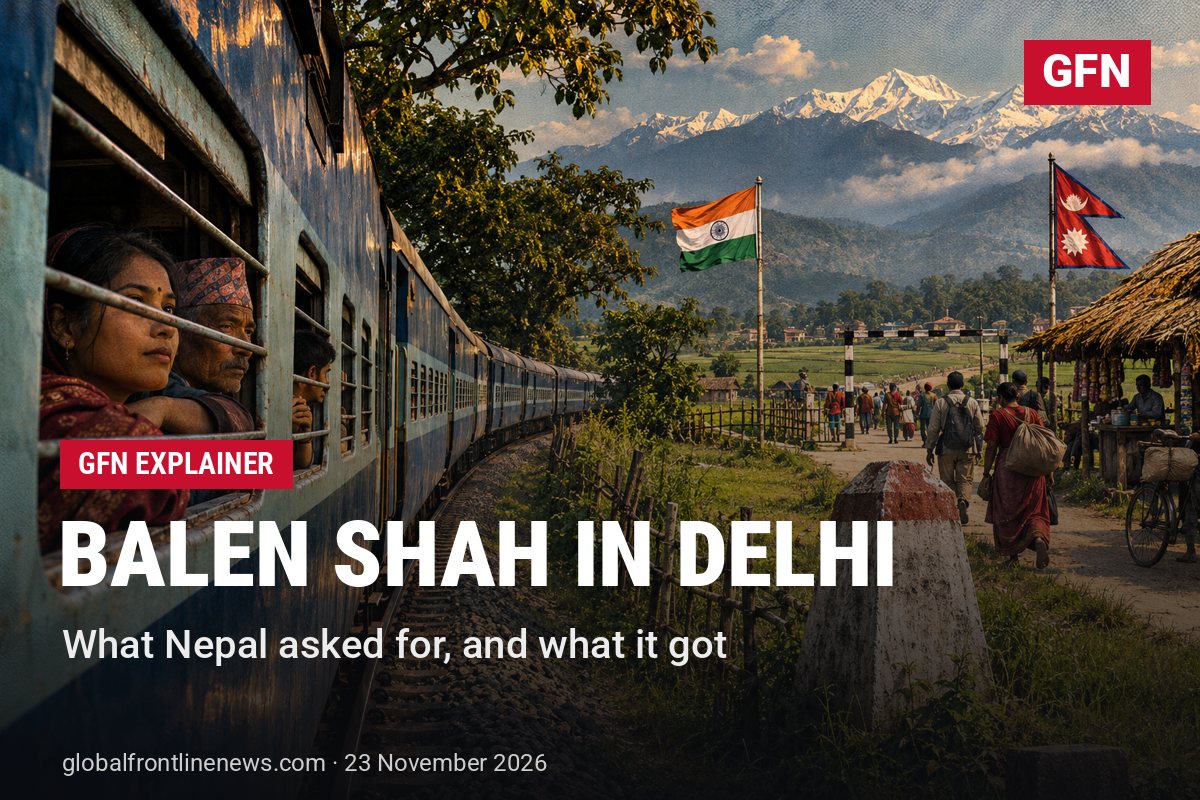
NEW DELHI — Balendra Shah, Nepal’s prime minister since March, made his first bilateral visit to India on November 22 and 23. A trip originally planned for four days was cut to about 25 hours in New Delhi. The centrepiece was delegation-level talks with Prime Minister Narendra Modi at Hyderabad House on Monday. Business Standard ↗ NewsBytes ↗ The Kathmandu Post ↗ ANI ↗ News24 ↗
The backdrop: Nepal’s worst floods in years
On August 26, floods tore through the Rasuwa–Bhotekoshi corridor north of Kathmandu. The Kathmandu Post reported at least 1,455 people killed, more than 9,000 injured and over 5,000 unaccounted for. Nepal’s own needs assessment puts damage at about $1.66 billion and overall recovery costs at $4.77 billion. The Kathmandu Post ↗ NewKerala / IANS ↗
What Kathmandu asked for
Nepal formally proposed a package of about $2 billion: $1 billion in concessional loans, $500 million in grants, and another $500 million for reconstruction and rehabilitation after the floods. Officials had also discussed using part of the money to upgrade the Siddhartha Highway between the border at Sunauli and Pokhara. The Kathmandu Post ↗ The Kathmandu Post ↗ The Kathmandu Post ↗
What India offered
Modi announced a development cooperation package worth 240 billion Nepalese rupees, about $1.62 billion, to support post-flood reconstruction and long-term development. That is below the $2 billion Kathmandu sought, and neither government has yet published how the package divides between grants and loans. Business Standard ↗ ANI ↗
For context, India already has four lines of credit running in Nepal worth a combined $1.65 billion, according to the Indian Embassy, and pledged $1 billion for reconstruction after the 2015 earthquake. News24 ↗
Eight agreements and six projects
The two sides exchanged eight memorandums of understanding. They cover forensic science and police training, civil service training, Ayurveda and traditional medicine, a satellite communication network built on the South Asia Satellite with ISRO, urban development, healthcare, and livestock and fisheries. Business Standard ↗ ANI ↗
Six projects were advanced: the new Saryu–Kamala Express passenger train linking Ayodhya with Janakpur, which the two leaders flagged off virtually; the foundation stone of an integrated check post at Banbasa; a new motorable bridge between Dharchula and Darchula; the foundation stone of the 669-megawatt Lower Arun hydropower project; the second phase of the Motihari–Amlekhgunj fuel pipeline; and a petroleum terminal in Jhapa that forms part of a planned pipeline from Siliguri. Business Standard ↗ Sambad English ↗
What was left unresolved
Three long-running issues did not feature in the announced outcomes. Nepal has sought extra air-entry routes from India since 2014 to make its new international airports at Bhairahawa and Pokhara viable; India has reportedly been positive but nothing final has been agreed. The Pancheshwar multipurpose dam on the Mahakali river, conceived under a 1996 treaty, remains stalled even though the two sides have reportedly narrowed differences on how to split its cost. The Kathmandu Post ↗
The border disputes over Kalapani, Limpiyadhura and Susta were also not part of the announcements. Shah’s own position has shifted over time: as Kathmandu mayor he displayed a ‘Greater Nepal’ map in his office, but in May 2026 he said Nepal had also encroached on Indian land, a remark seen in Nepal as a softening. The Kathmandu Post ↗
What it means
Both leaders framed the visit as a fresh start. Modi spoke of writing a ‘golden chapter’ in ties, while Shah described the relationship as built on mutual respect and trust. The financial package gives Nepal real help with flood recovery, but the hardest questions — air routes, Pancheshwar and the border — have been postponed rather than solved, and will test whether the new warmth lasts. Business Standard ↗ The Kathmandu Post ↗