Why India should be less dependent on the United States
India can protect a valuable partnership by giving its exporters more customers, its companies the freedom to switch technology suppliers, and its armed forces the ability to maintain equipment at home.
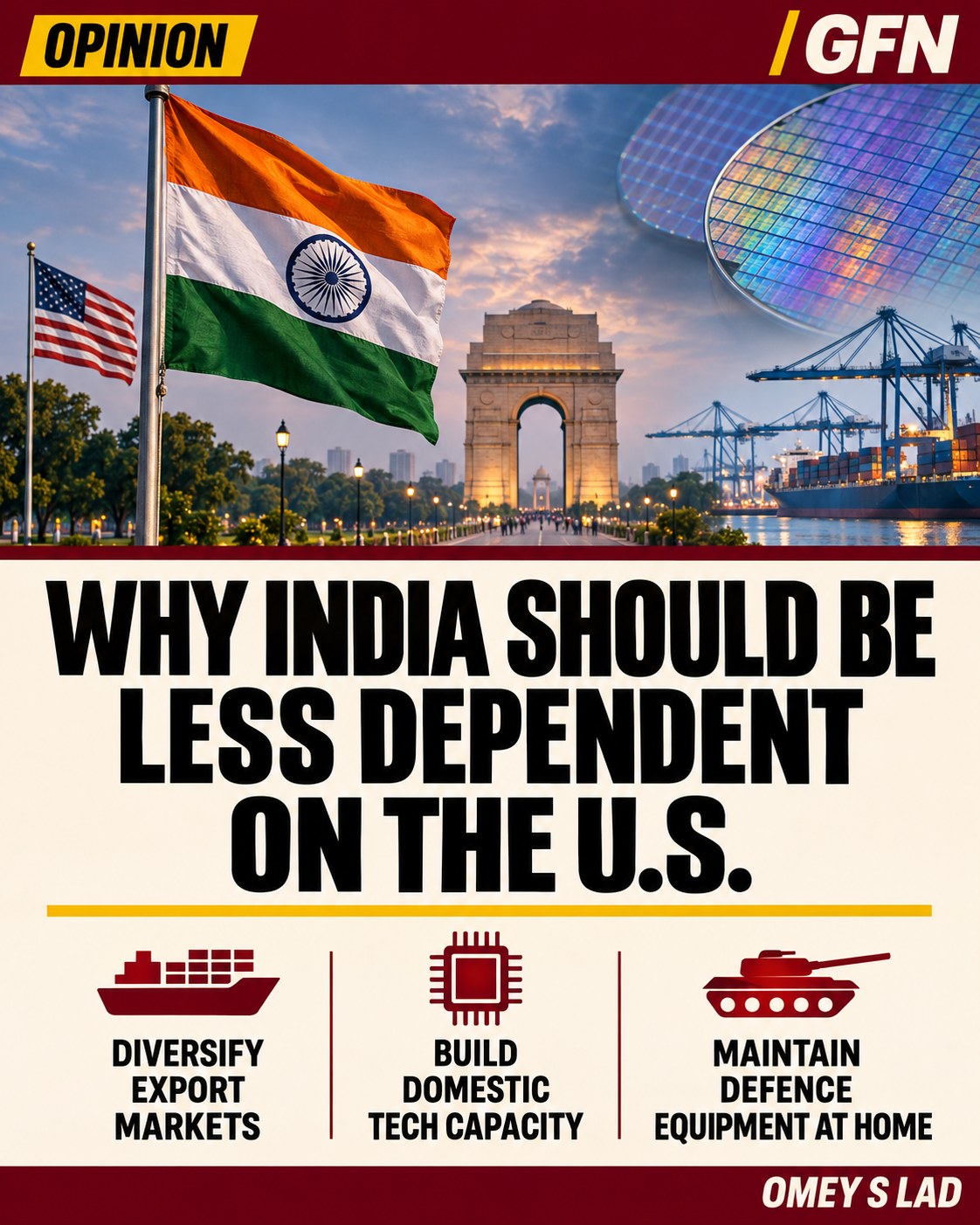
NEW DELHI — India has good reasons to deepen its relationship with the United States. The two countries traded an estimated $239.6 billion in goods and services in 2025, and their technology partnership covers semiconductors, AI and critical minerals. A relationship this valuable is worth protecting. India can do that by building more options for its exporters, technology companies and defence industry, so that a policy change in Washington has less power to disrupt decisions in New Delhi. USTR ↗
Give Indian exporters more customers
The United States accounted for 54.1% of India’s software services exports in FY2025–26, according to the Reserve Bank of India. That concentration makes Indian IT companies particularly exposed to a downturn in American corporate spending or changes in U.S. visa rules. Growing sales in Europe, the Gulf and Asia would help companies absorb a slowdown in any one market while giving them more room to grow. Reserve Bank of India ↗
India’s trade agreement with the European Free Trade Association entered into force in October 2025, and India and the EU concluded negotiations on a separate free trade agreement in January 2026. The next test is whether Indian businesses can turn those agreements into lasting customer relationships.
Build the ability to switch technology suppliers
American companies and universities can help India advance in chip design, AI and research. India gains more from these partnerships when they also train local engineers, support Indian research teams and leave businesses free to switch suppliers. A bank or hospital, for example, should be able to move its data and essential software to another cloud provider without rebuilding its entire system. The White House ↗
In semiconductors, India can focus on areas where it can build commercial expertise, such as chip design, packaging and testing, while working with multiple international partners.
Judge defence deals by what India can sustain at home
India’s experience with Russia shows how long supplier dependence can persist. SIPRI estimates that Russia’s share of Indian major arms imports fell from 70% in 2011–15 to 40% in 2021–25 as India diversified towards suppliers including France, Israel and the U.S. SIPRI ↗
Future deals should give India the ability to maintain equipment, secure spare parts and carry out upgrades domestically. A wider supplier base helps, but the practical test is whether India can keep equipment in service when an overseas supply chain is disrupted.
What strategic autonomy looks like
India can keep building a strong partnership with the United States while making its economy and security less vulnerable to decisions made abroad. That is what strategic autonomy looks like in practice. An exporter can find another buyer, a company can change technology providers, and the armed forces can maintain essential equipment at home. Each of those options gives India more room to act in its own interests.